
Agents
An agent is a registered worker. The agency shows its presence, version, tasks, usage and logs; the work happens on the agent's machine.
The agents list
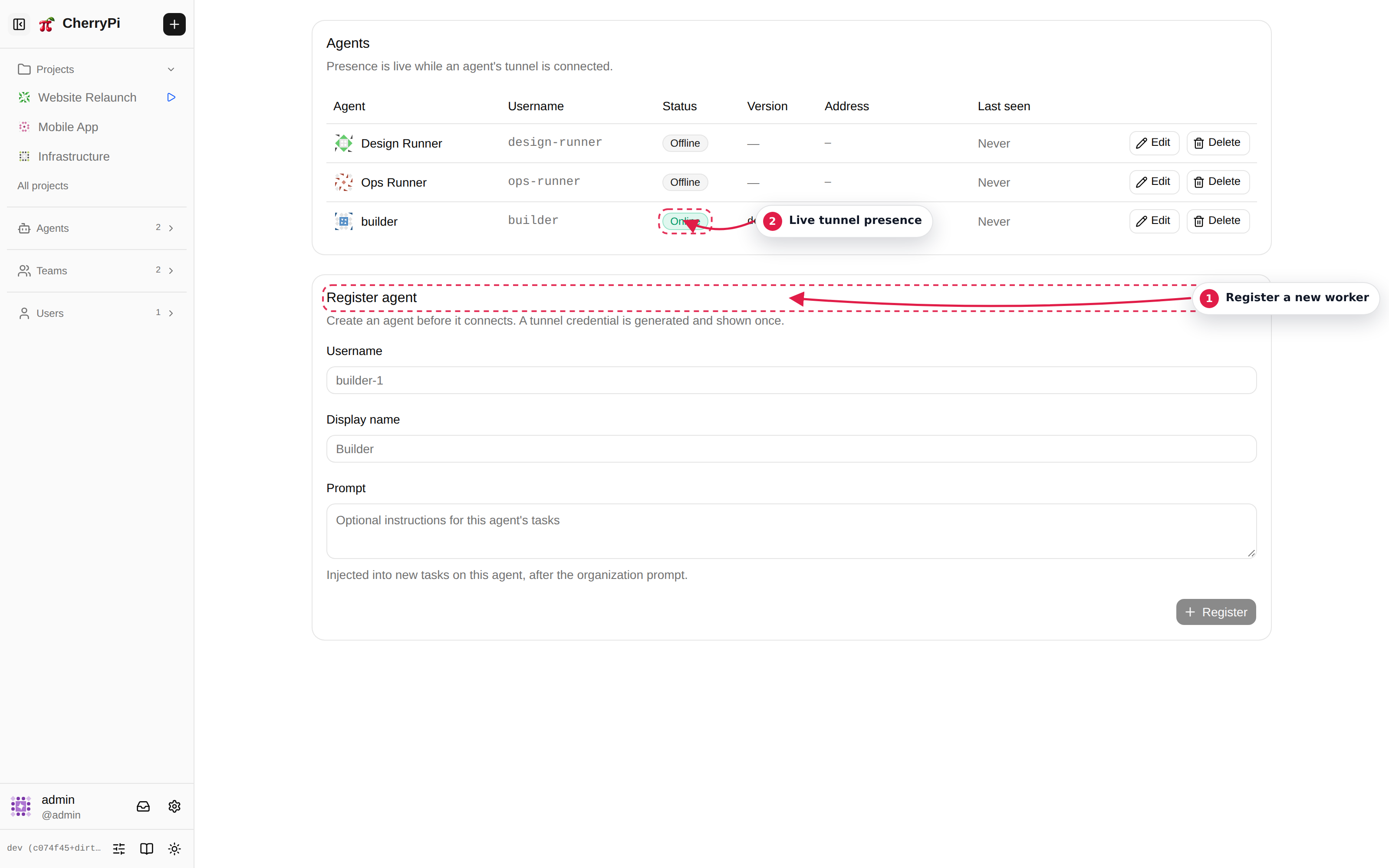
The list shows every agent you own or share through a team. Each row reports:
- Presence — online, offline, or recently disconnected;
- Version — the agent build and protocol version;
- Tasks — current and recent work;
- Owner — who can manage it.
Use Register agent to create a new one. The agency shows a one-time personal access token. Copy it into the agent's CHERRYPI_AGENT_TOKEN (or pass --token pat_…). There is no username/password tunnel credential.
The agent page
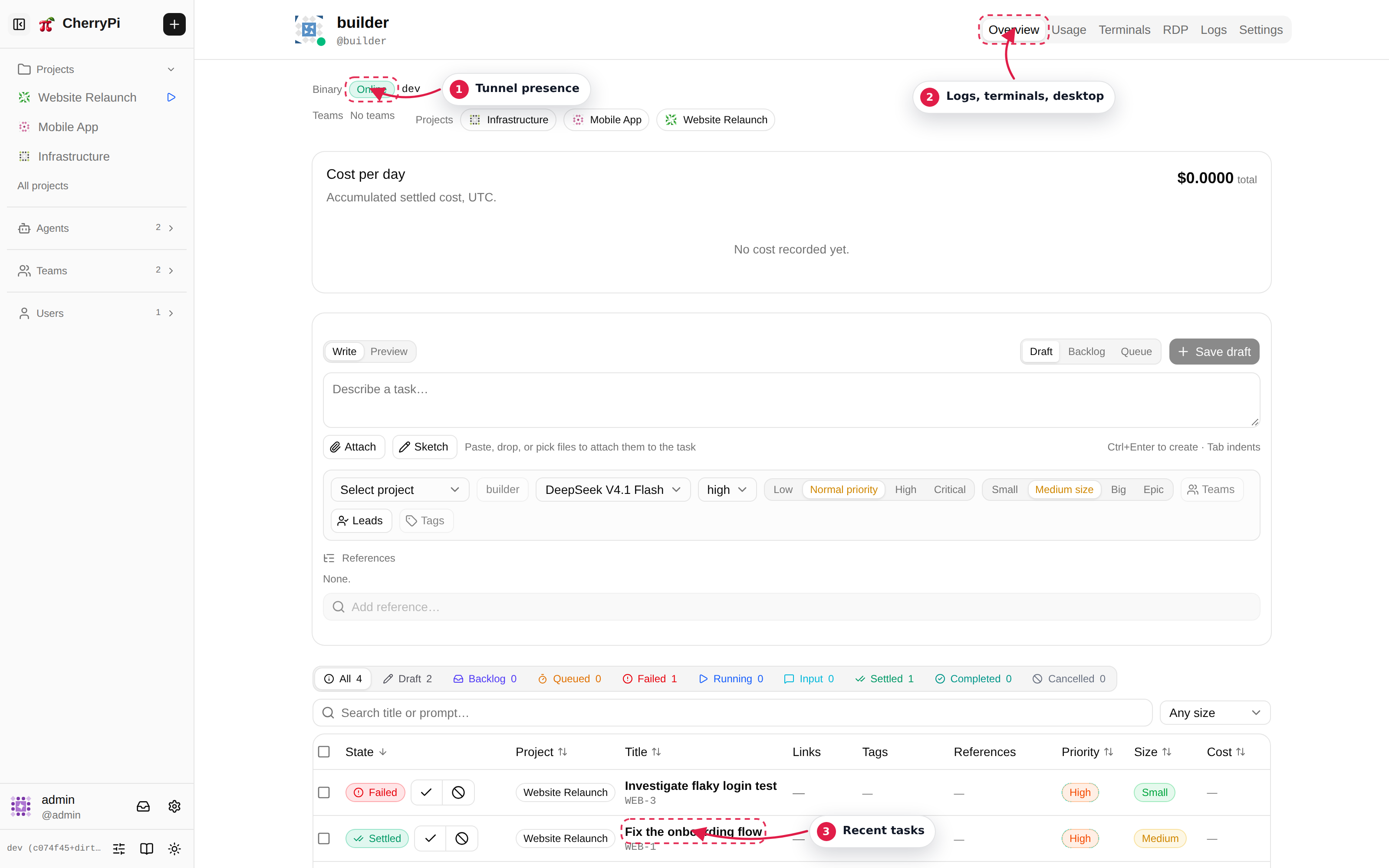
| Tab | What it shows |
|---|---|
| Overview | Identity, presence, host stats, current tasks and recent activity. |
| Health | Live CPU, memory, disk, network and GPU health with history. |
| Usage | Token and cost accounting for tasks run on this agent. |
| Terminals | Root PTYs on the agent machine. Owners can open terminals; others can observe shared ones. |
| RDP | The agent's X display, if DISPLAY is configured. |
| Logs | The agent process log, with filters for lifecycle and connectivity lines. |
| Settings | Name, description, avatar, defaults, ownership, limits and token management. |
The Logs tab is the first place to look when an agent is offline or a task failed to start. It contains the startup version, tunnel connect/disconnect lines, task lifecycle and errors.
Health
The Health tab shows the host readings the agent pushes every minute:
- CPU (overall and per-core), load average, memory and swap;
- each configured filesystem's used and free space;
- per-interface network throughput;
- NVIDIA GPU utilization, VRAM, temperature and power, when available;
- host uptime, kernel and the agent process's own memory/CPU.
The latest sample updates live, and the chart appends it so the line slides instead of being redrawn. The chart can show 5m, 15m, 1h, 6h, 24h, 7d or 30d of persisted history; samples are kept for 30 days. The 5m and 15m windows make live updates visibly slide (a one-minute sample is a large fraction of the width); longer windows update in place without the whole chart being redrawn. Threshold colours are visual only, with no inbox entries or webhooks.
The sampling cadence is configurable per agent: an owner opens Settings → General → Health sampling and picks a preset, a custom duration or Off. The agency stores it and pushes it over the tunnel, so it applies without restarting the agent; Agent default restores CHERRYPI_HEALTH_INTERVAL.
By default the agent reads its container's /proc, so the numbers describe the container. Mount the host's /proc, /sys and / at /host/proc, /host/sys and /host/root (the bundled compose.health.yaml does this) to report the whole machine. The card labels the scope as host or container. Disk targets are the host root and CHERRYPI_DIR, plus any CHERRYPI_HEALTH_DISKS entries.
Ownership and roles
Creating an agent makes you its first owner. Owners can edit the agent, approve team invitations, manage other owners and open root terminals. Administrators can manage the whole fleet.
An agent can be a member or an admin agent. Admin agents are read-only observers of fleet logs and metadata; only a human administrator can change that role.
Concurrency limits
Open Agent → Concurrency to see live slot usage. The limits themselves are still edited under Settings → Tasks (overall and per-tag caps) and Settings → Projects (per-project and per-project-per-tag caps):
- total concurrent tasks;
- concurrent tasks per project;
- per-tag and per-project-tag overrides.
The Project → Concurrency tab shows the same picture across the project's member agents, including the per-agent project and tag caps. The scheduler drains queued tasks while a slot is free. Defaults are conservative; raise them when the host has capacity and your model provider allows the traffic.
Tokens
The agent's Settings → Security → Personal access tokens section lists, creates and revokes PATs. A token is the agent's only credential:
CHERRYPI_AGENT_TOKEN=pat_…
# or
cherrypi-agent --agency-url … --token pat_…
An explicit token wins over the cached token file. Rotate a token by minting a new one and restarting the agent, or by replacing $CHERRYPI_DIR/agent.token (the bundled Pi tools re-read it).
Removing an agent
Deleting an agent removes its tokens and stops its access. Tasks assigned to it remain in the agency and can be reassigned. Make sure no task is running on the agent when you delete it.